

The best bespoke tailor in Dubai is judged by process, not showroom size — check that they name their actual fabric mills, offer at least two to three fittings (not just one), give a written quote before cutting fabric, and can show real finished work rather than stock photos. Genuine bespoke means a pattern drafted from your measurements alone, not an adjusted standard block — ask this directly. Turnaround should run 2–4 weeks; anyone promising next-day bespoke is skipping fittings. Look for workshops with visible in-house production, like Shades in Al Quoz (est. 2008), and confirm their aftercare/adjustment policy before committing.
The best bespoke tailor in Dubai is not only going to have a nice showroom or a huge variety of fabrics. A tailor should be using authentic and traceable fabrics, having enough fittings if required, showing the samples of finished clothes, and stating service charges clearly before starting the job. A few of the practical details indicated above are often more important than an expensive showroom, a list of many famous clients, and a skilled salesperson.
The options for tailoring in Dubai are extensive. You can visit areas like Karama, Al Quoz, or Business Bay, where you will come across so many shops advertising “bespoke suits” and “custom tailoring.” However, it is unlikely that you will find those who actually understand custom tailoring and would deliver garments still appealing to wear even after five years. This guide explains the distinctions between the practice of tailoring and the true art of it.
Search “bespoke tailoring Dubai,” and the results will show you everything from genuine ateliers to high-street shops that simply adjust a stock pattern and charge accordingly. In the industry’s original sense, “bespoke” means a garment built from an individual pattern cut for one person, with no reused template. Made-to-measure, by contrast, starts from an existing block pattern that’s then adjusted to your measurements—faster, cheaper, and perfectly fine for most people, but not the same craft. The Savile Row Bespoke Association, the trade body that represents London’s historic bespoke tailoring houses, defines true bespoke as a garment cut from an individually drafted pattern and built through multiple fitting stages—a useful benchmark even outside London.
The problem is that in Dubai, both terms get used interchangeably in shop signage and Instagram ads. A tailor advertising “bespoke” work might genuinely be drafting a pattern from scratch, or might simply be adjusting a standard block and charging bespoke prices for it. The only way to know which one you’re getting is to ask directly: “Is this pattern drafted from my measurements alone, or adjusted from a standard block?” A tailor confident in their process will answer without hesitation.
Three things make Dubai a slightly different market than London or Milan. First, the climate: a suit built for European weight and lining will feel unbearable by May, so fabric weight and breathability need to be part of the conversation from day one, not an afterthought. Second, the business culture: Dubai’s DIFC, Business Bay, and government sector still run on formal, modest dress expectations—a standard the UAE Government Portal sets out clearly for professional and public settings alike—so the margin for a badly fitted suit showing up at a client meeting is thinner than in more casual markets. Third, the city’s transient, multicultural population means many residents are choosing a tailor for the first time with no local word-of-mouth to rely on—which is exactly the gap this guide is meant to close.
Ask where the cloth comes from. A tailor who genuinely works with quality fabric will name the mill or region without hesitation—Italian wool houses, English worsteds, or Egyptian cotton for shirting. If the answer is a vague “we use good quality fabric,” that’s your first signal to keep asking questions. For Dubai’s climate specifically, ask about weight (the 110s to 150s range for suiting works well here) and whether a half- or full-canvas construction is used; as Black Lapel’s guide to jacket construction explains, canvassed jackets are stitched rather than glued, which is exactly why they hold their shape far longer in heat and humidity than fused ones.
A single fitting is not bespoke tailoring—it’s a hopeful guess. A proper process includes a baste fitting (checking the rough shell of the garment), a second fitting after adjustments, and often a final check before collection. Workshops that have been refining this process for years, including established names like Shades in Al Quoz, typically build two to three fittings into the timeline as standard, not as an upsell. If a tailor is promising a finished bespoke suit after one visit, the fit is being estimated, not tailored.
Genuine bespoke work takes time—pattern drafting, cutting, hand or machine basting, fitting, adjusting, and finishing. In Dubai, the duration for making a custom-tailored suit runs from 2 to 4 weeks, although this period may run longer during wedding seasons or Eid festivals. If someone claims they could deliver your garment in less than 48 hours, know that this is impossible without skipping fittings or using a pre-made block.
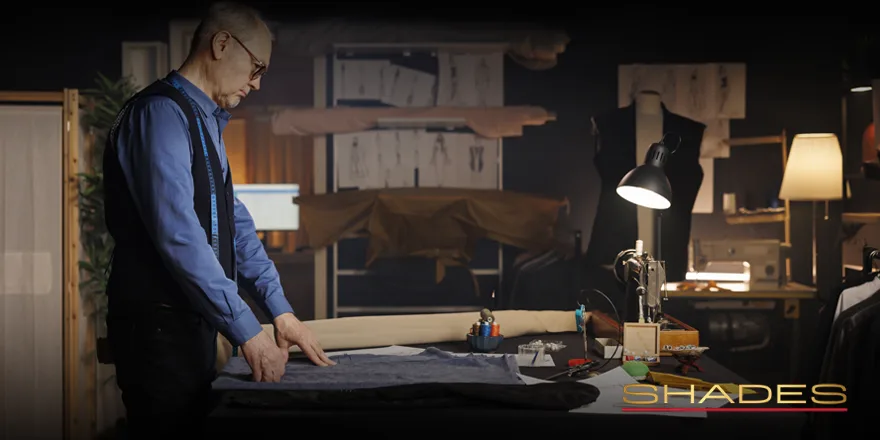
Stock photography and international catalogue images tell you nothing about the tailor standing in front of you. Ask to see finished garments made in-house—ideally with a client’s permission to share photos or work in progress on the cutting table. A workshop confident in its craftsmanship will usually show you around; one that can’t produce a single photo of its own finished work is worth a second thought.
Ask where the cloth comes from. A tailor who genuinely works with quality fabric will name the mill or region without hesitation—Italian wool houses, English worsteds, or Egyptian cotton for shirting. If the answer is a vague “we use good quality fabric,” that’s your first signal to keep asking questions. For Dubai’s climate specifically, ask about weight (the 110s to 150s range for suiting works well here) and whether a half- or full-canvas construction is used; as Black Lapel’s guide to jacket construction explains, canvassed jackets are stitched rather than glued, which is exactly why they hold their shape far longer in heat and humidity than fused ones.
Bodies change, and even a well-fitted garment sometimes needs a small adjustment weeks or months later. Ask upfront what the aftercare policy looks like—many established Dubai tailors, Shades included, offer free or low-cost adjustments within a set period after delivery. If it’s an older piece rather than a new commission, it may be a smaller job for a clothing alterations guide rather than a full bespoke order—worth knowing before you assume a full remake is needed. A tailor with no answer to the aftercare question at all is telling you something about how they view the relationship after the sale is made.
Wherever you can, try to choose a tailor who allows you to observe the actual workshop instead of the retail counter. Al Quoz has turned into somewhat of an informal area for tailoring in Dubai because the workshops there integrate the showroom and working area, bringing about the opportunity to evaluate the operation properly rather than relying on the shop’s promise.
Use this table as a checklist during your first consultation. If a tailor clears most of the green-flag column, you’re likely in good hands.
Checkpoint | What to Ask | Green Flag | Red Flag |
Fabric sourcing | “Where does the cloth come from?” | Names actual mills (Italian, English, or regional) | Vague answer like “good quality fabric” |
Fittings | “How many fittings before delivery?” | At least two to three, spaced out | One fitting, or none at all |
Turnaround | “How long from order to delivery?” | 2–4 weeks, explained clearly | Promises next-day bespoke |
Portfolio | “Can I see finished work, not sketches?” | Real photos, real clients, on request | Only stock photos or catalogue images |
Pricing | “What’s included in this price?” | Written quote before cutting starts | Verbal estimate that changes later |
Aftercare | “What if the fit needs adjusting later?” | Free or low-cost adjustment policy | No aftercare policy at all |
An effective first consultation tends to feel less like a sales pitch and more like a fitting. During the consultation, the tailor will get the initial idea of the purpose behind the clothing (to work, to wear on special occasions, or as day-to-day wear), take actual measurements instead of sticking to the one-size-fits-all concept, and discuss the different fabrics, depending on how frequently it will be used and what the climate will be. In workshops, especially those that have more experience in that field, such as Shades, founded in 2008 in Al Quoz, the consultation would also involve talking about whether the piece is canvassed or fused.
If a consultation feels rushed or skips straight to a price without discussing fabric and fit, that’s usually a preview of how the rest of the process will go. And if the visit is for a work wardrobe rather than a single suit, it’s worth reading how to dress professionally for Dubai’s business environment alongside this guide, since the two decisions—who cuts the suit and how you build the wardrobe around it—go hand in hand.
The process of choosing the right bespoke tailor Dubai residents actually recommend to friends isn’t about choosing the most impressive store or getting the lowest price, but about finding a business that makes fabric, fits, and finishes their prioritized steps instead of optional extras. Ask the seven questions below, watch for the red flags, and you’ll walk into your first consultation with more clarity than most people bring to their fifth. And if you’re outfitting a team rather than yourself, the same scrutiny applies—our corporate uniforms buying guide covers the B2B side of that decision in detail.
Prices vary widely based on fabric grade and construction, but a genuinely bespoke suit in Dubai typically starts in the higher range compared to made-to-measure, reflecting the extra fittings and hand-finishing involved. Always get a written quote before committing.
Most reputable tailors in Dubai build in two to three fittings: an initial baste fitting, a follow-up adjustment fitting, and a final check before the garment is delivered.
Bespoke starts from a pattern drafted individually for you; made-to-measure adjusts an existing standard pattern to your measurements. Both can produce a great result, but only one is technically bespoke.
Two to four weeks is typical, though this can extend during wedding season or Eid. Be wary of anyone promising bespoke delivery in a day or two.
Many can, though it's worth confirming this during your first consultation, since some workshops prefer to control fabric sourcing to guarantee the final result.
How to Choose the Best Bespoke Tailor in Dubai? The best bespoke tailor in Dubai is judged by process, not showroom size — check that

Corporate Uniforms in Dubai: Complete Buying Guide Corporate uniforms in Dubai must balance branding, comfort in 45°C+ heat, and UAE safety compliance. Businesses can choose

Best Clothing Alteration Services in Dubai: What Can Be Tailored? Yes — most clothing can be altered in Dubai, including hemming and length adjustments, waist
